
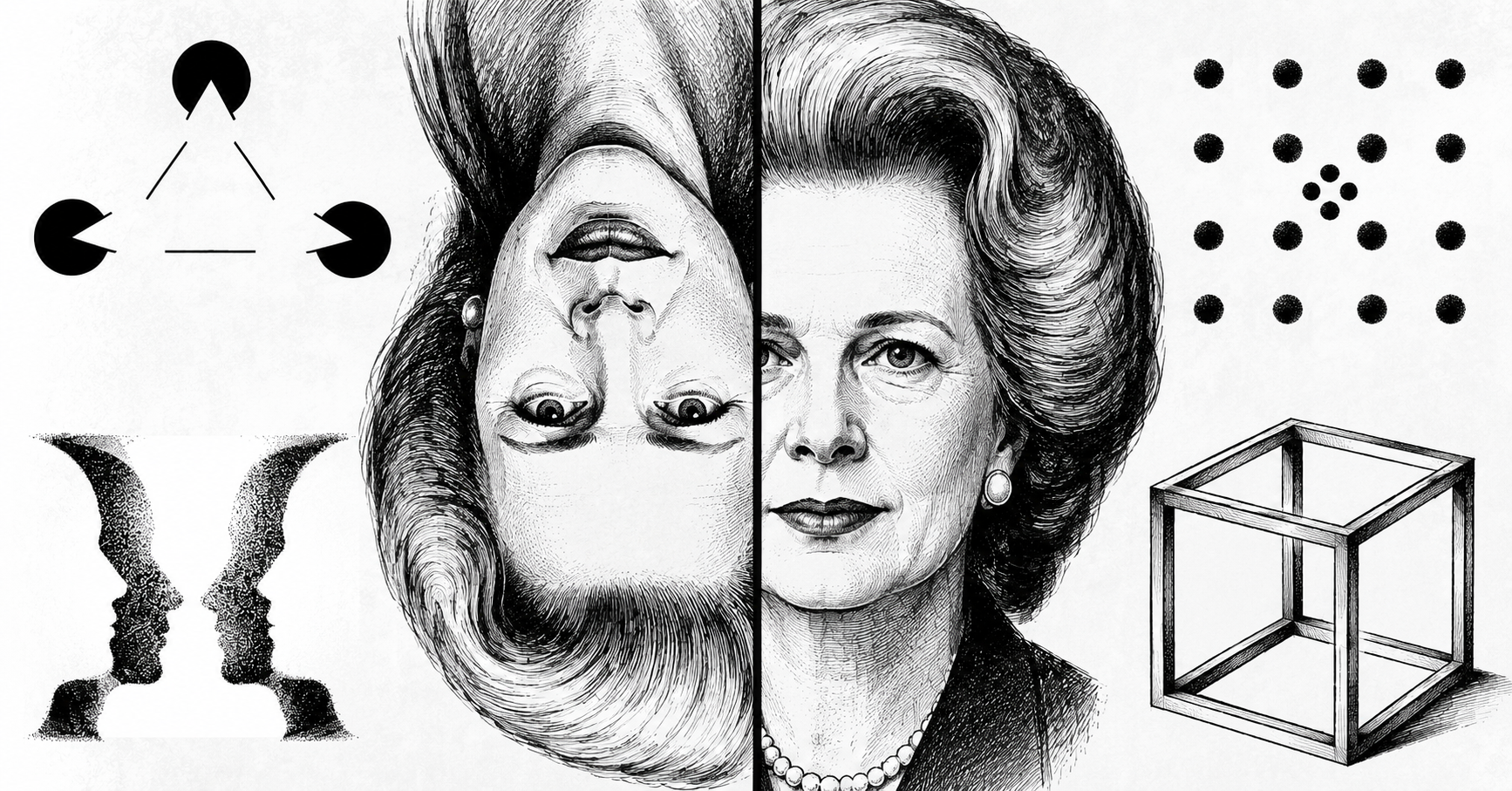

“The whole is greater than the sum of its individual parts.”
It’s one of the most famous ideas in psychology, but at first it doesn’t seem to make much sense. How can a whole be greater than the pieces that make it up?
Take a look at the image below. The faces may seem fairly normal, even if something feels a bit off. Now rotate the image 180 degrees.
Suddenly, the faces look horrifying.
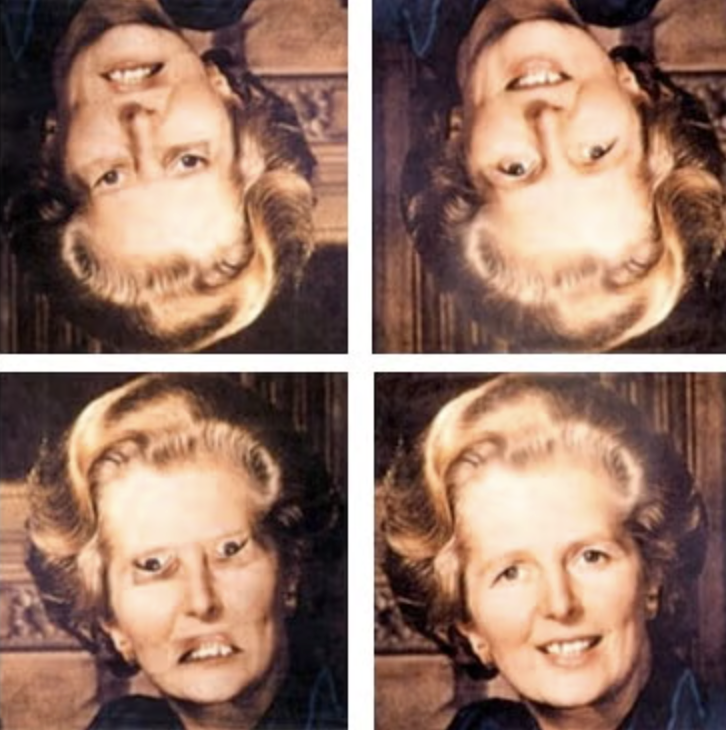
Known as the Thatcher Illusion, this demonstration was created by psychologist Peter Thompson in 1980. The eyes and mouth have been flipped upside down, yet most people barely notice when the face itself is inverted. Turn it upright, however, and the distortions become impossible to ignore.
The illusion reveals a central idea of Gestalt psychology, the notion that our brains don’t perceive the world piece by piece. Instead, they rapidly organize separate bits of information into meaningful patterns. In other words, we don’t consciously see two eyes, a nose, and a mouth before recognizing a face. We perceive the face as a complete whole.
That’s what the quote above means about the sum and whole. A face is more than a collection of features. The relationships among those features create something entirely new. The same is true when you recognize a melody instead of individual notes, or read a sentence instead of isolated letters. These new concepts and meanings emerge. The brain is constantly assembling pieces into patterns that carry meaning.
Most of the time, this remarkable shortcut helps us navigate the world with incredible speed. Occasionally, though, it makes mistakes. The Thatcher Illusion works because turning a face upside down disrupts the brain’s normal face-processing system, making obvious distortions surprisingly difficult to detect.
READ ALSO: When Your Brain Disagrees With Itself
Our brains are extraordinary pattern-recognition machines, capable of transforming millions of bits of sensory information into a coherent experience almost instantly. But that incredible efficiency comes with trade-offs. Sometimes the shortcuts that allow us to navigate the world effortlessly also leave us vulnerable to remarkably convincing illusions.
The next time you feel certain that your eyes are telling you the complete story, remember that your brain has already edited it. And chances are, you never noticed.


Leave a Reply
You must be logged in to post a comment.