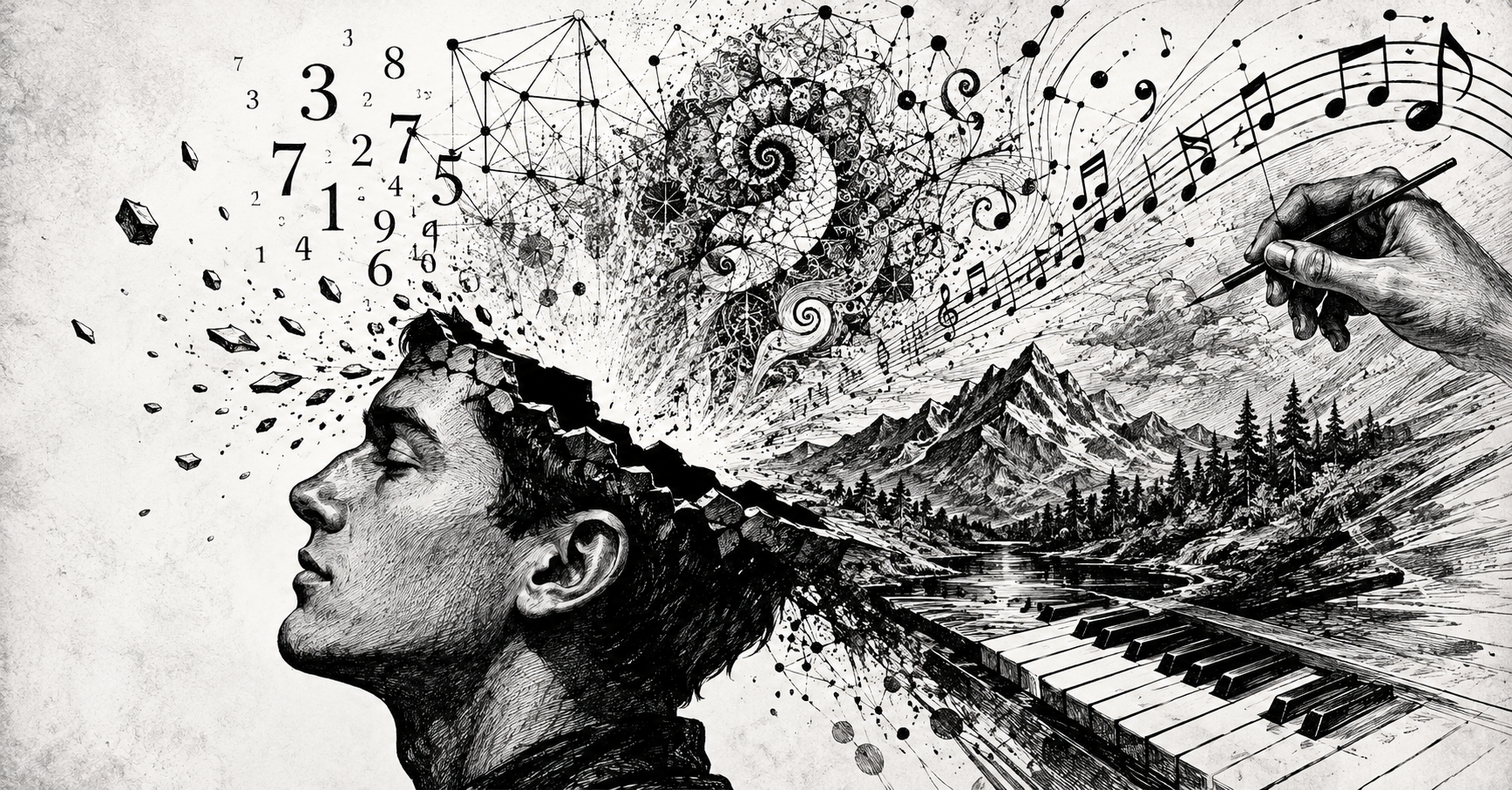
Imagine getting hit in the head during a random accident… and then waking up able to paint breathtaking landscapes or suddenly “see” advanced mathematics everywhere around you.
No, this is not a Marvel origin story. It’s something neuroscience calls Acquired Savant Syndrome, and it may be one of the most fascinating psychological phenomena ever documented.
In total, scientists have documented less than 100 people with the syndrome, but in these rare cases, individuals with no previous extraordinary abilities experienced some sort of neurological trauma (e.g., concussion, stroke, seizure, etc.) and then suddenly developed remarkable talents.
What’s going on in these instances?
Some Well-Known Cases of “Accidental Genius”
One of the most famous cases is Jason Padgett, a former furniture salesman who was violently assaulted outside a karaoke bar in 2002. Before the attack, he reportedly had little interest in mathematics. Afterward, he began seeing geometric patterns everywhere and developed extraordinary mathematical visualization abilities. He later became deeply involved in advanced mathematics and fractal geometry.
Another well-known case involves Derek Amato, who suffered a concussion after diving into a shallow pool. (By the way, this is literally one of my greatest fears!) Soon after, he developed an intense ability to play piano despite having no formal musical training beforehand.
There are also documented cases of people suddenly becoming gifted painters after strokes, developing calendar-calculation abilities after head injuries, or demonstrating incredible memory skills following neurological trauma.
All this raises a fascinating possibility: What if the brain already contains abilities we normally cannot access??
The Brain’s “Hidden Software”
Psychiatrist Darold Treffert spent much of his career studying savant syndrome and helped popularize the idea that extraordinary abilities may exist in a kind of “dormant” state within the brain.
One major theory suggests that injury to certain areas of the left hemisphere may reduce inhibition in other regions of the brain, particularly parts of the right hemisphere associated with pattern recognition, music, spatial processing, and artistic perception.
In simpler terms: damage to one system may accidentally remove the brain’s filters.
Normally, our brains prioritize efficiency. We ignore enormous amounts of sensory detail because paying attention to everything would be too overwhelming. But some researchers believe acquired savants may gain access to lower-level perceptual processing that most people never consciously experience.
That sounds great, right? Unfortunately, many acquired savants also describe intense anxiety, obsessive thoughts, sensory overload, or feeling psychologically disconnected from the world they previously knew.
So this may be less of a superpower and more of a neurological disruption.
Could Everyone Have an “Inner Savant”?
Some scientists have proposed that savant-like abilities may exist in all humans to some degree, but are normally inaccessible because higher-level cognitive systems suppress raw detail processing.
There have even been experiments using transcranial magnetic stimulation (TMS), where temporarily disrupting parts of the brain caused ordinary participants to show brief improvements in drawing accuracy or pattern detection.
The findings are controversial and far from conclusive, but they hint at something psychologically profound: Human cognition may involve trade-offs.
The same systems that help us function socially, think abstractly, and navigate daily life may also filter out massive amounts of information that could otherwise produce extraordinary abilities.
Basically, your brain may be hiding information from you on purpose. Thanks, evolution!
Why This Fascinates Us So Much
Acquired savant syndrome taps directly into one of humanity’s oldest obsessions: the idea that genius is hidden inside us, waiting to be unlocked.
Movies love this idea. Stories love this idea. Psychology students love this idea!
But the reality is more complicated.
Most acquired savants did not simply “gain powers.” They experienced trauma, neurological damage, major personality changes, or severe emotional distress alongside their newfound skills.
Still, the phenomenon forces researchers to rethink how intelligence works. Maybe human intellect is not just about what the brain can do, but also what the brain prevents itself from doing.
We are quite a ways from fully understanding the human condition, but exceptional cases like those with Acquired Savant Syndrome give us a glimpse at the edges of what’s possible.