Every October, millions of people turn fear into a kind of celebration. Yards fill with skeletons and inflatable ghosts, horror films top streaming charts, and crowds gather for haunted mazes designed to make hearts race. Fear becomes a shared ritual and a thrill people seek out on purpose. Beneath the costumes and fake cobwebs lies something more intriguing: an invitation to let our own nervous systems run wild, to feel the surge of adrenaline and relief that comes from being scared and safe at the same time. What exactly are we doing when we lean into fear on purpose?
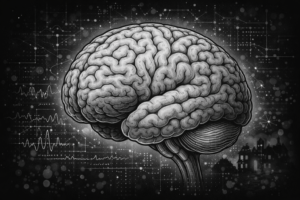
At the center of that experience sits the amygdala, a small almond-shaped structure deep in the temporal lobe that acts like a threat detector. It is part of what Joseph LeDoux called the “low road” of emotional processing, meaning it can react before the slower, more thoughtful parts of the brain have fully identified what is happening (LeDoux, 1996). You hear a sudden noise in a haunted maze and your body is already in motion before you realize it was only a prop or sound effect. The amygdala sends signals to the hypothalamus, which flips on the sympathetic nervous system. Heart rate increases, breathing changes, pupils widen, and muscles tense. The endocrine system releases adrenaline and cortisol, priming the body to act. In that moment, every cell is preparing for one basic question: “Am I safe?”
What makes Halloween fascinating is that it activates that circuitry in a context where the answer is already yes. The masked figure around the corner looks like a threat, but the prefrontal cortex, which handles reasoning and self-control, quickly interprets the situation and reminds us that we are safe. In other words, the amygdala sends the alarm while the prefrontal cortex provides reassurance. That internal tug-of-war between raw emotion and rational understanding is where the psychological thrill begins.
Other brain regions contribute to this dynamic. The hippocampus helps with memory and context, reminding us that it is Halloween, that this is temporary, and that nothing truly bad happened last year. The bed nucleus of the stria terminalis (BNST), which maintains sustained states of anxiety, keeps us on edge as we move through a haunted house not knowing what comes next. When the “threat” passes, reward systems in the brain light up. Dopamine activity in areas like the nucleus accumbens brings a wave of pleasure and relief, often followed by laughter or the impulse to go again. The body does not only create fear; it rewards us for surviving it.
This cycle is what makes “safe fear” so appealing. You experience physiological arousal without real danger. The sympathetic nervous system fires, and then the parasympathetic system brings everything back down. That drop can feel calming and even euphoric. Neurochemically, it creates a sequence of norepinephrine and adrenaline for alertness, followed by endorphins and dopamine for recovery. It is a biological roller coaster that keeps people coming back for more.
Joseph Wolpe’s (1958) work on systematic desensitization provides a psychological explanation for why this kind of controlled fear can feel enjoyable. Wolpe found that pairing fear-inducing stimuli with safety or relaxation can weaken the fear response over time. In neuroscience terms, this reflects the adage, “neurons that fire together wire together.” If the brain consistently pairs the experience of fear with cues of safety, the connection between danger and panic weakens. Haunted houses and horror films do this intuitively. They expose us to frightening sights and sounds, but in an environment surrounded by friends, laughter, and choice. Social support itself reduces amygdala activation (Phelps et al., 2005), which is one reason people instinctively reach for someone’s hand during a jump scare.
There is also an evolutionary and developmental logic to all of this. Human brains are designed to learn about threats through experience. Controlled exposure to fear may help calibrate the threat detection system, teaching it when to respond strongly and when to stand down. Children do this through ghost stories at sleepovers, teenagers through horror films, and adults through extreme haunted attractions or true crime shows. The brain rehearses the cycle of alarm, response, and recovery, strengthening emotional regulation.
Some people are especially drawn to intense horror experiences. This can relate to higher sensation-seeking traits, which have been linked to dopamine function, or to the feeling of mastery that comes from staying calm in stressful situations. Keeping the prefrontal cortex in control while the amygdala sounds the alarm can be satisfying—it proves that you can handle your fear.
When October ends and the decorations come down, what lingers is not the plastic spiders but the memory of how easily our own biology can produce and then dissolve fear. Halloween highlights how the emotional brain is fast, powerful, and adaptive. It shows that fear is not only a defense mechanism but also a source of excitement and joy when safely explored. To feel afraid and then safe again is to experience one of the brain’s most ancient circuits in motion.