Stress itself is not the villain. Duration is. The human stress response evolved to deal with short bursts of danger, not long term uncertainty, unresolved pressure, or the low hum of modern life. When a system designed for emergencies is forced to operate continuously, it stops being protective and starts becoming destructive.
From an evolutionary perspective, stress works exactly as intended. From a modern perspective, it is badly mismatched to the environment we now inhabit.
Built for Survival, Not Permanence
When the brain detects threat, the hypothalamus activates the HPA axis. Signals travel from the hypothalamus to the pituitary and then to the adrenal glands, releasing cortisol and other stress hormones. Heart rate increases, glucose is mobilized, digestion slows, and nonessential systems are temporarily suppressed. This response increases the odds of survival in the short term.
The critical assumption built into this system is that the threat will end. Once danger passes, cortisol levels drop and the body returns to baseline. That recovery phase is not optional. It is the reset button.
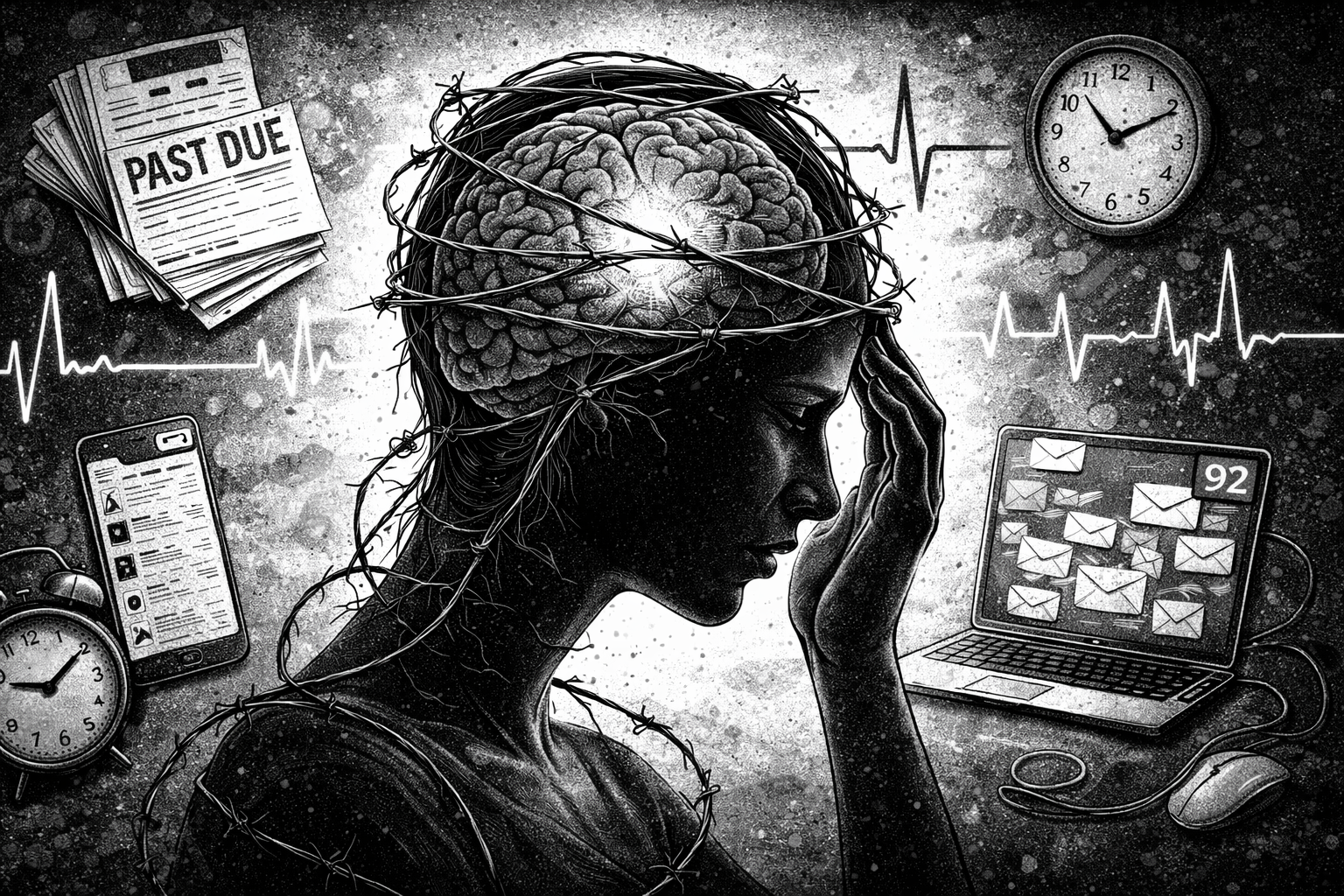
Modern stressors rarely provide that reset. Deadlines, financial concerns, social conflict, health anxiety, and constant information exposure all keep the brain in a state of perceived threat without clear resolution. The stress response remains active because, biologically speaking, the danger never fully disappears.
What Happens When Cortisol Never Leaves
Chronic activation of the stress response has measurable physiological consequences. Prolonged cortisol exposure impairs hippocampal functioning, which affects memory and learning. It disrupts sleep and circadian rhythms. It weakens immune functioning over time. It contributes to insulin resistance and visceral fat accumulation. It also heightens amygdala reactivity, making future stress responses faster and more intense.
Stanford’s Robert Sapolsky demonstrated these effects across decades of research. In both animal and human studies, chronic stress is associated with dendritic retraction in the hippocampus and impairments in memory formation (Sapolsky, 1996). In primate populations, individuals with less social control and predictability show higher baseline cortisol and increased rates of stress related disease (Sapolsky, 2005).
The takeaway is not that stress is harmful by default. It is that stress without recovery changes the brain and body in lasting ways.
Predictability Matters More Than Intensity
One of the most striking demonstrations of this comes from classic animal research on stress, predictability, and control. In a series of experiments, rats were exposed to identical electric shocks. The key manipulation was whether the shock was preceded by a warning signal.
Rats that received a brief signal before the shock showed significantly lower physiological stress responses than rats that received the same shock without warning. Despite identical physical exposure, unpredictable shock produced greater gastric ulcers, higher cortisol levels, and more long term health damage (Weiss, 1970).
In related work, rats given control over terminating a shock showed dramatically reduced stress responses compared to rats with no control, even when total shock exposure was the same (Weiss, 1968). Predictability and control altered the biological impact of stress more than intensity did.
This research laid the groundwork for later studies on learned helplessness by Maier and Seligman (1976), showing that uncontrollable stress leads to behavioral shutdown, impaired learning, and depressive like symptoms.
The implication for humans is uncomfortable but clear. Uncertainty is often more stressful than pain. A known stressor allows the nervous system to prepare and recover. An unpredictable one keeps the system activated indefinitely.
Selye, Freud, and the Cost of Prolonged Alarm
Hans Selye was the first to describe stress as a general biological response rather than a stimulus specific one. His General Adaptation Syndrome outlined three stages: alarm, resistance, and exhaustion (Selye, 1956). Chronic stress pushes the body into the exhaustion phase, where adaptive capacity breaks down and disease risk increases.
Long before cortisol could be measured, Sigmund Freud conceptualized psychological distress as unresolved internal conflict. While Freud lacked a biological framework, the core idea aligns with modern stress research. Unresolved threats, whether external or internal, maintain physiological tension.
Moreover, in Freud’s Civilization and Its Discontents, he argues that anxiety is the price we pay for civilization. In other words, other animals don’t worry about the same ‘human’ problems we do, like stuffed email inboxes, financial strain, work deadlines, and more.
Modern neuroscience bridges these perspectives. Stress is not defined solely by exposure. It is defined by whether the brain believes the threat is predictable, controllable, and resolvable.
The deeper problem is mismatch. Our stress systems evolved in environments where threats were acute and time limited. Modern life supplies chronic stressors that are abstract, social, and ongoing.
The result is a survival system that works too well for the wrong context.
Understanding this reframes chronic stress. It is not a failure of resilience or mindset. It is arguably a biological system operating outside the conditions it evolved for. The most effective interventions are not about eliminating stress entirely, but about restoring recovery, predictability, and a sense of control.
Stress was never meant to be permanent. When it becomes a constant background state, the body pays the price.




Leave a Reply
You must be logged in to post a comment.