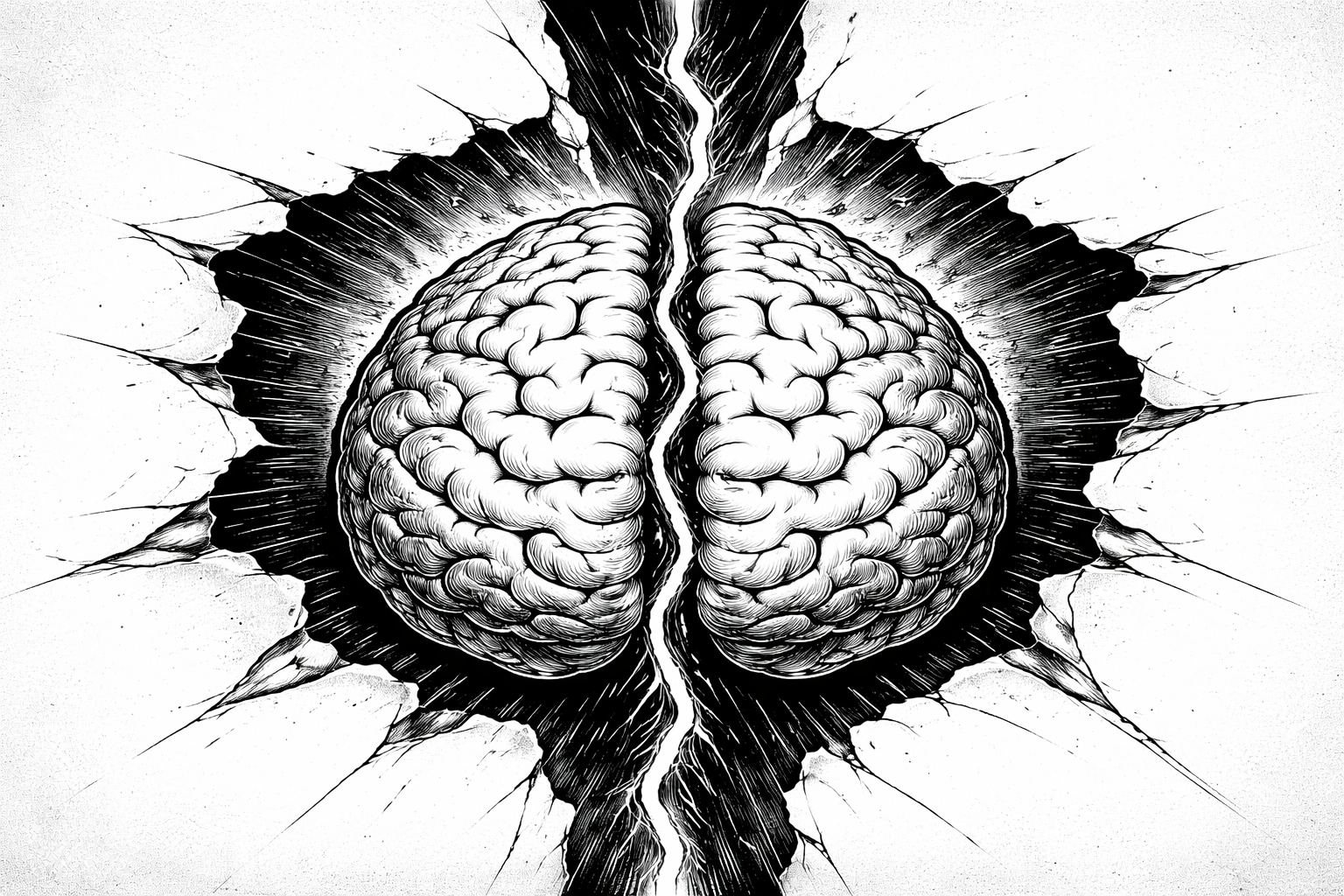
For most of us, it feels obvious that there is a single “self” inside our head making decisions, interpreting the world, and guiding our actions. But some of the most fascinating research in psychology and neuroscience suggests that this feeling of unity may actually be something our brain constructs. Few areas of research illustrate this better than studies of split-brain patients.
Split-brain patients are individuals who underwent a surgery called a corpus callosotomy, typically performed decades ago as a treatment for severe epilepsy. The procedure cuts the corpus callosum, the thick bundle of neural fibers that normally connects the brain’s left and right hemispheres. In everyday life, the hemispheres communicate constantly, sharing information in fractions of a second. When that connection is severed, the hemispheres can no longer easily exchange information, allowing researchers to observe what each side of the brain can do independently.
The results were astonishing.
Much of the early work was conducted by neuroscientists Roger Sperry and Michael Gazzaniga in the 1960s. Their experiments took advantage of how vision works. Information from the right visual field is processed in the left hemisphere, while information from the left visual field is processed in the right hemisphere. By briefly flashing images to one side of a screen, researchers could send information to only one hemisphere at a time.
What they found suggested that the hemispheres could process information separately, sometimes leading to surprisingly different responses.
In one famous experiment, a split-brain patient was shown two images simultaneously. The right visual field (left hemisphere) saw a chicken claw, while the left visual field (right hemisphere) saw a snowy landscape. The participant was then asked to choose related images using each hand. The right hand selected a chicken, while the left hand selected a snow shovel, which were perfect responses from each hemisphere.
But the real surprise came next…
When the patient was asked why they chose the shovel, the speaking left hemisphere had never seen the snowy scene. Instead of saying “I don’t know,” the patient confidently explained that the shovel was needed to clean out the chicken coop. The brain had essentially invented a story to make sense of the behavior.
Gazzaniga later referred to this phenomenon as the “left-brain interpreter.” The left hemisphere appears to specialize in building explanations and narratives that make our behavior feel coherent, even when the real cause lies elsewhere in the brain.
Other experiments revealed equally strange findings. When an object was placed in a split-brain patient’s left hand, the right hemisphere could recognize it through touch. But because the left hemisphere controls speech, the patient often could not verbally identify what they were holding. They might say they were holding nothing, yet could still correctly pick the object from a group using their left hand.
Even more bizarre, some split-brain patients experienced moments when their hands appeared to work against each other. One hand might button a shirt while the other unbuttons it. One hand might reach for an object while the other pushes it away. These behaviors highlight how each hemisphere can sometimes act with a degree of independence when communication between them is disrupted.
Perhaps most intriguing are cases suggesting that the hemispheres can hold different interpretations of the world. In one widely discussed anecdote described by neurologist V. S. Ramachandran, a split-brain patient was asked whether they believed in God. Because speech comes from the left hemisphere, the patient verbally answered no. But when the right hemisphere was asked the same question using a pointing response instead of speech, it indicated yes.
This does not mean one side of the brain is religious and the other atheist. Rather, it demonstrates that beliefs and interpretations may be distributed across multiple neural systems, each contributing to the overall sense of self.
Despite these dramatic findings, split-brain patients do not walk around feeling like two separate people. In everyday life, they function remarkably normally. This suggests that the brain has many other pathways and strategies for coordinating activity across regions. The mind is not easily divided into two independent selves.
What this research ultimately reveals is not that we have two minds, but that the mind is far more complex and distributed than our subjective experience suggests. The sense of being a single, unified thinker may be more like a carefully coordinated conversation among many neural processes.
In other words, the brain may be less like a single commander issuing orders and more like a committee constantly negotiating what to do next. And yet, somehow, it usually feels like just one voice in our head. That illusion of unity may be one of the brain’s most impressive achievements.




Leave a Reply
You must be logged in to post a comment.