A small strip of brain tissue shows up in studies on attention, mistakes, pain, anxiety, motivation, social rejection, self control, and more. It is not flashy, but it is everywhere. If the brain had a place that constantly asked, “Is this important?” the anterior cingulate cortex, or ACC, would be a strong candidate.
What makes the ACC especially fascinating is that it seems to care less about what you are doing and more about how much it matters.
Where the ACC sits and why that matters
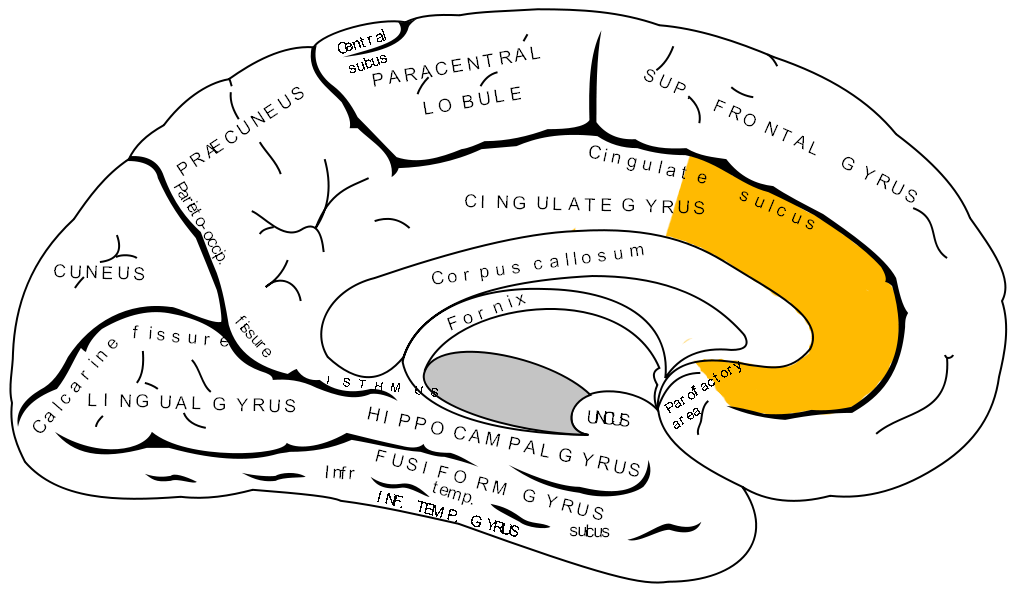
The ACC runs along the middle of the brain, just above the corpus callosum. Because of where it is located, it connects to brain areas involved in thinking, emotion, movement, and even heart rate and sweating. This positioning allows it to integrate information about goals, feelings, and bodily signals all at once.
ACC highlighted in yellow. Source: Wikipedia
Early researchers described the ACC as a bridge between cognition and emotion, rather than a region that fits neatly into one category (Bush, Luu, & Posner, 2000). That basic idea still holds up today.
The ACC notices when something feels wrong
One of the ACC’s most consistent roles is detecting conflict and errors. It becomes active when you make a mistake, feel uncertain, or face competing choices.
Classic experiments like the Stroop task (see YouTube clip below from SciSchow) reliably activate the ACC when people must override an automatic response, such as saying the color of the ink instead of reading the word (Botvinick et al., 2001). Even more interesting, the ACC responds not only when you make a mistake, but sometimes when you almost make one.
EEG research shows a signal called the error-related negativity, or ERN, which appears milliseconds after an error and is strongly linked to ACC activity. Your brain flags the mistake before you are fully aware of it.
The ACC decides whether effort is worth it
More recent theories suggest the ACC does more than point out problems. It may help decide how much effort to invest.
According to the Expected Value of Control model, the ACC weighs the difficulty of a task, the potential reward, and the mental cost of trying harder (Shenhav, Botvinick, & Cohen, 2013). If the effort seems worth it, control increases. If not, motivation drops.
This explains why the ACC is active when studying for an exam, resisting a habit, or pushing through boredom. It is involved in that internal debate of “Should I keep going or give up?”
Pain, social rejection, and the ACC alarm system
As discussed in a prior WTFreud article, the ACC is also deeply involved in the emotional side of pain. It responds strongly to physical pain, but it also activates during experiences like social exclusion.
In a well known study, participants were excluded from a virtual ball tossing game, and this social rejection triggered ACC activity along with feelings of distress (Eisenberger, Lieberman, & Williams, 2003). This finding led to the popular idea that social pain and physical pain share neural systems.
Later research complicated the story. Some studies suggest the ACC may be responding less to pain itself and more to salience or threat, meaning how important or alarming something feels (Woo et al., 2014). In other words, the ACC may function like an alarm that goes off when something demands attention, whether it is a stubbed toe or being ignored by friends.
More findings that keep the ACC interesting
The ACC appears in some surprisingly odd studies. For example, it becomes active when people experience cognitive dissonance, such as defending a choice they secretly regret. It also activates when people feel the urge to check something again, even when they know it is unnecessary, which helps explain its role in obsessive-compulsive disorder.
In one line of research, monks trained in meditation show altered ACC activity, suggesting that practices involving sustained attention and emotional regulation may reshape how this region responds to conflict and distress (Tang, Hölzel, & Posner, 2015).
There is even evidence that the ACC responds when people watch others make mistakes, hinting that it plays a role in learning socially, not just from our own errors.
The ACC and mental health
The ACC is often overactive in anxiety disorders and OCD. When the brain’s error or alarm system becomes too sensitive, everyday situations can feel urgent or wrong even when nothing is actually dangerous.
This fits with the ACC’s core role. If your brain constantly signals that something is off, you may feel driven to worry, check, or correct things over and over. Neuroimaging studies repeatedly find ACC involvement in these conditions, especially during uncertainty and decision making (Pauls et al., 2014).
How to think about the ACC
Rather than thinking of the ACC as a single function brain region, it may be more accurate to think of it as a priority setter. It helps decide what deserves attention, effort, and emotional weight.
The ACC is active when you notice mistakes, feel mental strain, experience distress, or push yourself to keep going. These are not small details of human life. They are the moments when behavior changes.
The anterior cingulate cortex is compelling because it sits right where experience turns into action. It is involved when something feels difficult, important, uncomfortable, or worth trying harder for. The ACC does not just help you think or feel. It helps you decide when to care.
That may be why the ACC shows up so often in psychology and neuroscience. It is not responsible for a single behavior. It is involved in the decision to engage at all. If psychology is about understanding why humans struggle, persist, worry, and grow, then the ACC is not just interesting, it is central.








Leave a Reply
You must be logged in to post a comment.