If Abraham Maslow were alive today, he’d probably be both fascinated and a little horrified by the world we’ve built. His famous hierarchy of needs, first introduced in 1943, described human motivation as a ladder we climb from survival to self-fulfillment. We start with basic physiological needs (food, water, rest), move through safety and belonging, reach for esteem, and finally, if we’re lucky, arrive at self-actualization and becoming the best version of ourselves. Later in his life, Maslow even hinted at a sixth level: self-transcendence, where people look beyond their own needs and work toward the good of humanity as a whole.
But Maslow lived in a world without AI, social media, or smartphones. If he were here in 2025, he’d probably say the hierarchy still holds true, but each level has changed shape in surprising ways.
At the very bottom, physiological needs aren’t just about food and shelter anymore. In the digital age, access to electricity, Wi-Fi, and technology has become essential to survival in work, education, and even relationships. During the COVID-19 pandemic, internet access became the difference between connection and isolation, especially for students and remote workers. Research shows that when people lack reliable access to technology, they also experience higher anxiety and lower well-being (Twenge et al., 2019). It’s fair to say that in modern life, digital access is as crucial as clean water once was.
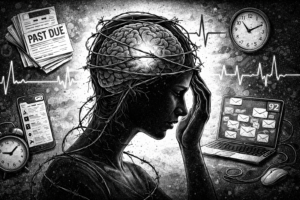
Moving up, safety is no longer just about physical security. It’s about mental and informational safety too. The modern threats are more psychological: constant exposure to misinformation, the fear of job automation, economic instability, and the sense that our attention is being sold off to the highest bidder. Studies have found that heavy exposure to online falsehoods and surveillance-driven media correlates with stress and lower trust in society (Nguyen et al., 2025). For many people, feeling safe now means protecting their mind — not just their body — from burnout and manipulation.
Next comes love and belonging, which may be the most paradoxical level of all. We’re more connected than ever, yet so many people report feeling alone. Social media gives us the illusion of closeness, but it often replaces depth with dopamine. A major study by Cigna (2020) found that loneliness has risen to record highs in the United States, despite nonstop digital communication. And it’s not just about having people around, it’s about being known. Even Facebook’s own research has shown that the emotional tone of our feeds can shift our mood (see Kramer et al., 2014, for a fascinating, yet seemingly wildly unethical study). Maslow might say that the modern person’s greatest challenge is distinguishing real belonging from the illusion of it.
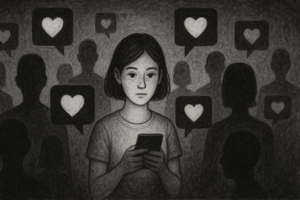
At the esteem level, Maslow talked about two forms: the desire for recognition and the deeper need for self-respect. That tension is magnified in today’s “metrics culture,” where self-worth can seem tied to likes, followers, or productivity stats. Social comparison theory has long found that scrolling through others’ highlight reels can lower our self-esteem and mood (Vogel et al., 2014). Maslow would likely warn that esteem built on comparison is too fragile and that real esteem comes from integrity and competence, not algorithms or applause.
Finally, self-actualization, the top of the pyramid, still represents the drive to grow, create, and live meaningfully. But what does that look like when machines can paint portraits, write poetry, and even mimic empathy? Maslow might argue that the goal now isn’t just to create, but to stay conscious of what makes us human. Self-actualization today is about awareness, moral imagination, and the capacity for awe. Research in positive psychology echoes this idea: true fulfillment comes when people feel autonomous, capable, and connected to others in authentic ways (Ryan & Deci, 2000). Our greatest challenge isn’t that AI will replace us, it’s perhaps that we’ll start living like machines ourselves, driven by efficiency over meaning.
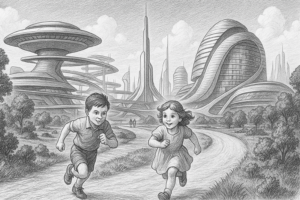
And then there’s self-transcendence, Maslow’s late addition, and a step beyond the self. He believed that the healthiest people move from personal growth to helping others grow, from self-interest to compassion. In a world facing climate change, political division, and economic inequality, that higher calling feels more urgent than ever. Studies show that people who find purpose in contributing to something larger than themselves experience greater happiness and resilience (Damon et al., 2003). Maslow might reframe his pyramid as a collective one now: self-actualization doesn’t mean much if the rest of the structure (our society, our planet, our humanity) is crumbling beneath us.
If Maslow could speak to us today, he’d probably say that our pyramid hasn’t changed, but the foundation is cracking. Our basic needs have become digital, our safety psychological, our belonging virtual, and our esteem dangerously externalized. Yet the path upward is still there. Becoming fully human means finding balance in this chaos: protecting our attention, seeking real connection, and using technology in ways that elevate rather than erode our humanity. In short, self-actualization today isn’t about escaping the world, it’s about navigating it consciously. In the age of machines, remembering what it means to be human may be our highest need of all.