Anyone who has played music in a group recognizes the moment when everything clicks. Timing feels effortless. No one is leading, yet everyone knows where the music is going. The sound seems to unfold on its own. Psychology and neuroscience suggest this feeling of unity is not just emotional language. It reflects real changes in attention, prediction, and brain activity.
Music as a Shared Predictive System
Music unfolds in time, which means it constantly pulls the brain forward. Musicians are always predicting what comes next, rhythmically and expressively. When people play together, those predictions must align. Research on ensemble performance shows that musicians synchronize their movements at extremely fine time scales, often within milliseconds, indicating shared internal timing mechanisms rather than simple reaction to sound alone (Keller, 2008).
This tight coordination allows performers to stay together even when the music becomes complex or expressive timing varies. The sense of effortlessness that players report comes from prediction working smoothly across individuals.
Brains That Sync Together
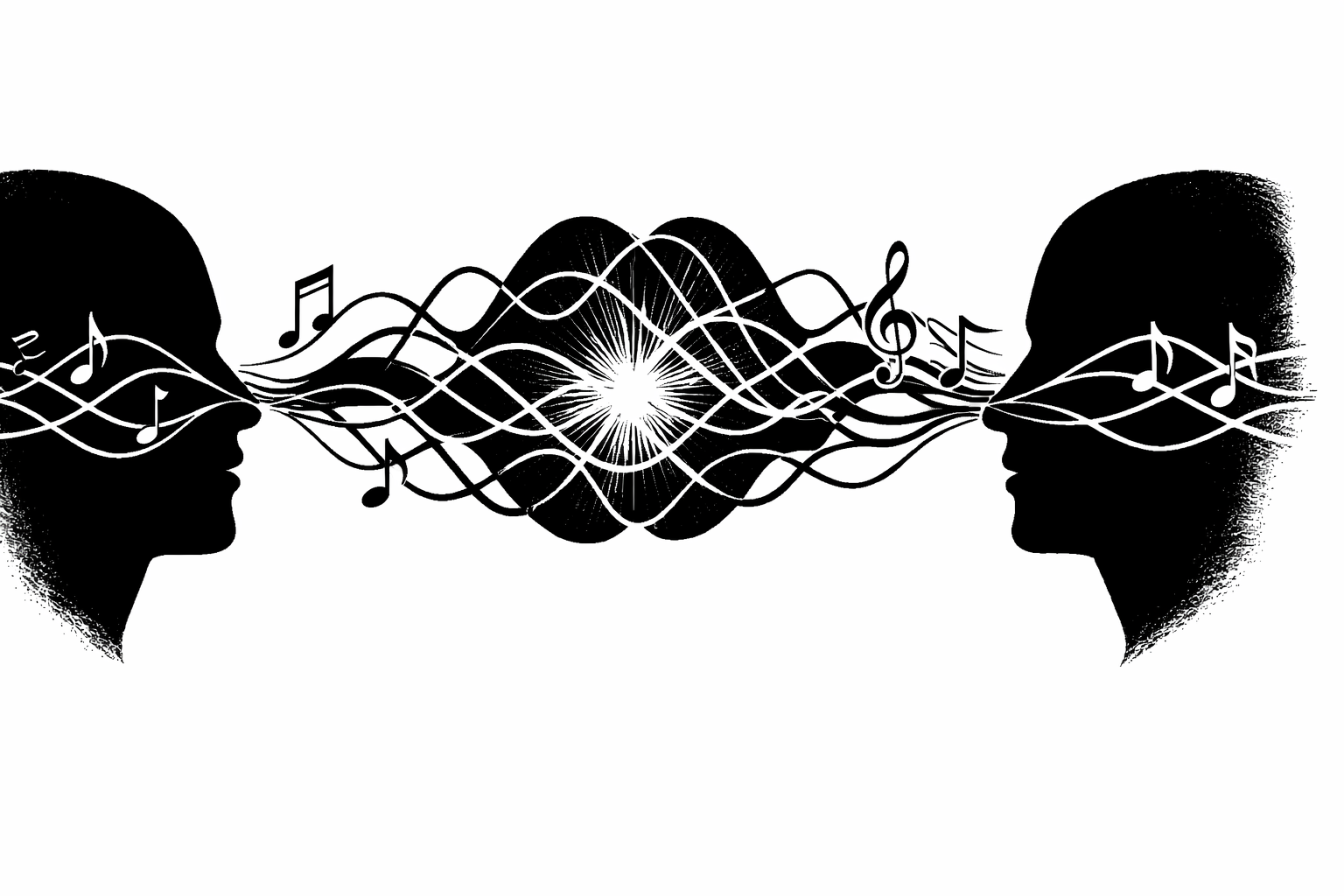
Coordination does not stop at behavior. Using EEG hyperscanning (simultaneously recording brain activity from multiple people as they interact), researchers have found that musicians show interbrain synchrony, meaning their neural activity becomes temporally aligned. This synchrony increases when performers share rhythm, coordinate entrances, and adapt to one another in real time (Lindenberger et al., 2009). Each person’s neural activity is shaped by the others, creating a biological foundation for the feeling of togetherness.
Flow is a psychological state marked by intense focus, reduced self-consciousness, altered time perception, and a sense that action unfolds automatically. In musical groups, this state often becomes collective. Researchers describe this as group flow, where shared goals, rapid feedback, and matched skill levels allow the entire ensemble to enter a deeply absorbed state together (Sawyer, 2006).
During group flow, attention shifts away from self-monitoring and toward the shared task. This helps explain why musicians often say they stop thinking about themselves and start feeling like part of something larger. Sometimes, a good jam session can take on a life of its own, felt deeply by the players themselves.
Improvisation and Emergent Creativity
Improvisation makes musical unity especially visible. Jazz musicians improvising together must create something new while remaining tightly coordinated. Studies show increased neural coupling during interactive improvisation, particularly when musicians respond to unexpected changes introduced by others (D’Ausilio et al., 2015).
What emerges often feels unplanned and unowned. Creativity arises from interaction rather than from any single individual, reinforcing the sense that the music is being created by the group as a whole. Jazz makes this synchronization especially fascinating because it demands real-time creativity without a script, forcing musicians to predict, adapt, and respond to one another instant by instant, turning coordination itself into a shared act of invention.
Shared Experience Beyond the Stage
This synchronization is not limited to performers. Research suggests that audience members’ brain activity can also synchronize during live performances, especially during emotionally engaging moments. Music can align attention and emotion across large groups, creating a shared experience among people who may not know each other at all (Dikker et al., 2017). Music, in this sense, acts as a social organizer of consciousness.
Why Music Feels Unifying
At the core of this phenomenon is neural entrainment. Brain rhythms naturally align to musical rhythms, organizing perception and action in time. When multiple people entrain to the same rhythmic structure, their experiences become coordinated (Large & Snyder, 2009).
The feeling of unity in music is not mystical, but it is remarkable. Consciousness remains individual, yet many of the processes that shape experience are shared. When musicians say they ‘lost themselves’ in the music, psychology offers one explanation. The self did not disappear. It became quieter, carried forward by a system of minds moving together through tempo.



Leave a Reply
You must be logged in to post a comment.